|
||||
|
| Home | Trips | About Trips | Dates & Prices | About Us | Photos | Reservations | Contact Us | |
|
Killer Whales (Oricnus orca)
The protection of Orca whales and their habitat is a priority for Pacific Northwest Expeditions, and we hope that your participation on one of our Johnstone Strait Orca sea kayaking trips will inspire your passion to protect these amazing creatures. Field studies of the natural history of killer whale populations off of the British Columbia coast have been conducted annually since 1973.
Killer Whale Identification CataloguesThe photo identification catalogues that we use on our sea kayaking and killer whale tours in johnstone Strait are now available online at the Fisheries and Oceans Canada Cetacean Research Program website. The identification catalogue for the Northern Resident Killer Whales of British Columbia. Killer Whale BiologyKiller whales are the largest members of the dolphin family. Their distinctive black and white colouring, dorsal fin, and size make them easy to distinguish from other cetaceans. Males are larger than females, and the adult male dorsal fin is much taller, (averaging 1.8 m or 5.5 ft. in height) than that of females and juveniles of either sex. Killer whales can be individually recognized by differences in the shape, size and position of their white eye patch and the saddle patch (behind the dorsal fin), as well as variations in the size, shape, angle and naturally-acquired nicks and scar of their dorsal fin. Although Killer Whales are not formally subdivided taxonomically there are three recognized 'ecotypes' off the west coast of North America: Resident, Bigg's (Transient), and Offshore. These three 'ecotypes' of Killer Whale are fundamentally different in most aspects of their behaviour, social organization, ecology, diets, and there are subtle physical differences. It is believed that these differences are so profound that the three ecotypes are socially and genetically isolated, despite living in the same waters.
RangeAs a species, Killer Whales occur in all oceans and seas of the world, however they prefer the colder waters of both hemispheres, with the greatest abundance found within 800 km of major continents. The 'Resident' ecotype is confined to the northwest coast of North America, from Washington State north to the western edge of the Gulf of Alaska. The 'Bigg's' orca range is confined to the northwest coast of North America, from central California north to Glacier Bay, Alaska. The 'Offshore' ecotype ranges along the west coast of North America, although the full extent of their range is not known. They have been observed from southern California north to southeast Alaska. There are approximately 300 northern and southern residents Killer whales in British Columbia waters and about 219 West Coast transients. About 200+ offshore whales have also been identified. No reliable world population estimate exists for killer whales.
Killer Whale Behaviour
Breach: occurs when a whale leaps out of the water, exposing two-thirds or more of its body. Clicking: a series of close-spaced, broad spectrum sounds, mainly at very high frequencies, made when echolocating. Each species of cetacean (whales, dolphins and porpoises) has distinct frequencies and patterns of clicks Dialect: a unique set of discrete calls made by an individual whale and fellow pod members; dialects of most resident pods can be distinguished either by ear or with a sound analyzer. Discrete call: a type of communication vocalization that sounds the same each time it is produced; on average, resident pods produce about twelve different types of discrete calls. Echolocation: the process by which killer whales and other toothed cetaceans use vocalizations to obtain information about their surroundings; similar to SONAR, echolation involves the production of rapid, high-frequency clicks that echo off objects in the whale's path. Foraging: is the most common activity of resident killer whales. Whales are foraging when they are feeding or appear to be searching for food. Fluking: when a whale or dolphin begins a deep dive, it lifts its tail into the air to help it thrust its body into a more steeply angled descent to deeper waters. Lobtailing: making a loud splash by forcefully slapping the flukes against the surface of the water peduncle-slapping also known as tail-breaching, throwing the rear portion of the body out of the water and slapping it sideways onto the surface, or on top of another whale. Socializing behaviour: includes various aerial displays participated in by all the whales in a group or only a few while the others may rest or forage. These activities are most often observed in juvenile whales and appear to be a form of playtime. Spyhop: a behaviour where a whale raises its head vertically above the water, then slips back below the surface; a spyhop seems to be a means of obtaining a view above the surface. Travelling: swimming forward consistently in one direction at a moderate to fast pace, usually in a tight formation.
Resident Killer WhalesRange
1) Northern Resident community, which ranges through the BC coastal waters from roughly the midpoint of Vancouver Island north to southeast Alaska. This is the population of Killer whales that we typically encounter on our Johnstone Strait sea kayaking trips. 2) Southern Resident community, which occupies waters off the southern half of Vancouver Island and Puget Sound in Washington State.
BiologyIt is estimated that mating occurs in Killer Whales in May–October, and the gestation period is 16–17 months. Usually only one calf is born. The mean life expectancy of female Killer Whales is estimated at 50 years and some may reach 80 years. In most cases, females give birth for the first time at 14 or 15 years and may produce young for the next 25 years at a calving interval of 3–8 years. Typical females may produce 4–6 surviving offspring in their lifetimes. Male Killer Whales reach sexual maturity at 12–14 years of age and physical maturity at about 20 years. The life span of males averages about 29 years, although some live to be at least 40.
DietThe diet of Resident Killer Whales consists predominantly of fish with 95% of observed kills being salmon, 60% of which are Chinook (King) Salmon.
Social Organization
A matriline consists of a group of closely related whales that are related to the matriarch (typically the oldest female) . Individuals travel together at all times and remain within the matriline for their entire lives. Offspring of both sexes stay with the mother as long as she is alive. A pod is a larger social unit consisting of related matrilines, and are often travelling with one another. A clan is the next level of Killer whale social structure and is identified by pods that share the same vocal dialect. Pods within a clan have probably descended from a common ancestral group and are probably more closely related to each other than to pods from other clans. A community comprises all pods that regularly associate with one another and will travel together at some time.
AbundanceThe Resident Killer Whale population as of 2010 in British Columbia is over 300 individuals: 261 individuals in the northern community and 86 individuals in the southern community. Northern Resident Population This population is currently listed by Committee on the Status of Endangered Wildlife in Canada (COSEWIC) as Threatened. Southern Resident Population In response to the significant population decline of the Southern Resident killer whales over the past decade, this population was listed as endangered under Canada’s Species at Risk Act in 2001, by Washington State in 2004, and under the U.S. Endangered Species Act in 2006.
Bigg's Killer Whales2012 UpdateJohn K.B. Ford and colleagues from Alaska to California want transient killer whales to be declared their own species, and they want them to have a new name: Bigg’s killer whales, in honor of the late Dr. Michael Bigg, the researcher whose observations led to the identification of transient orca and determined that individual whales could be identified by pigmentation patterns on the saddle patch at the base of their dorsal fins.
RangeThe west coast Bigg's population of Killer whales range encompasses the same waters as those used by the Resident Orca communities; British Columbia, Washington State, and Alaska.
Biology Physically, Bigg's Orca and Resident Orca are very similar but there are some differences. The top of the dorsal fin of Bigg's orcas tends to be more pointed, and the saddle patch ( the grey pigmentation along the side & behind the dorsal fin ) is further forward on these anaimals. The real difference between the two ecotypes is in their behaviour and their food preferences.
DietThe diet of Bigg's killer whales is made up of marine mammals with Harbour seals (more than 50% of documented kills) being the primary prey source. They also feed on Dall's and Harbour porpoises, and Northern and California Sea Lions, Pacific White sided dolphins, Gray, Minke and other whales.. They have also been observed harassing, killing, and occasionally eating sea birds. Their hunts are highly co-operative and coordinated efforts. Sometimes a hunt will take just minutes and at other times they last for several hours.
Social OrganizationThe social structure of the Bigg's killer whales is considerably different from that of the other ecotypes. Unlike the Resident killer whales, the social groupings of Bigg's whales are much more fluid and difficult to interpret. Individual animals do not necessarily stay with other closely related individuals and are frequently seen traveling alone. A typical Bigg's orca group might comprise a mother and two or three offspring, or perhaps several adult females of unknown relationship. Adult males often travel alone but may join with other Bigg's whales to form temporary foraging groups. The entire Bigg's orca population is linked through association, and are all acoustically linked through the sharing of calls.
AbundanceThis population was designated as ‘threatened’ by COSEWIC in 2001, and currently numbers approximately 250 animals. These killer whales are long-lived and are considered to be at risk because of their small population size, their very low reproductive rate (one calf every five years) and their extremely high levels of chemical contaminants that are persistent, bioaccumulative and toxic. The high contaminant levels are a result of contaminant bioaccumulation in their prey. This population of killer whales is currently listed as Threatened under Canada's Species at Risk Act.
Offshore Killer WhalesOffshore Killer whales are the least known of the three ecotypes of the northeastern Pacific Ocean. This population of Orca whales was first identified in the late 1980s and are most often found on the outer part of the continental shelf, but occasionally (rare) are sighted in the inshore waters. They are most often seen in large groups of 20 or more animals, and like the Resident Orca population are acoustically active. Offshore whales are thought to prey on fish, sharks, rays and skates, and they may also prey on marine mammals.
How You Can HelpGive a gift that will help protect the future of our wild killer whales! More than 30 years of research on killer whales has taught us about these magnificent animals. But there is still much more to learn. This is where YOU can help. By becoming a member of the B.C. Wild Killer Whale Adoption Program. you will be directly supporting research on killer whales.
|
|
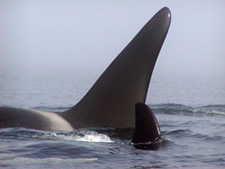 Our sea kayaking tours into Johnstone Strait and Blackfish Sound take us into the best coastal waters in North America in which to observe wild Killer Whales (Orca whales). Our time spent observing Killer Whales has inspired us to learn as much as we can about them and to play an active role in contributing to their conservation and survival.
 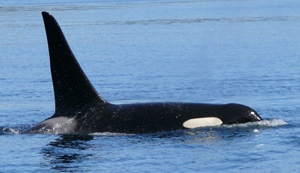 Beach Rubbing: is a behaviour common to the northern resident whales. It is most often observed at a series of small beaches within the Robson Bight (Michael Bigg) Ecological Reserve where the whales rub their bodies on the small, smooth pebbles, sometimes for several hours
 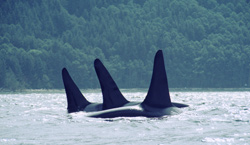 Resident Killer Whales occur throughout British Columbia’s coastal waters, but in summer tend to prefer protected inshore waters. Based on association patterns, acoustics, movements, and genetic differences, two Resident Killer Whale communities of 19 pods are recognized along the west coast of British Columbia:
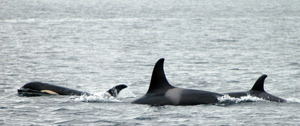 Resident Killer Whales have a complex social structure, organized into a series of social units along maternal lines.
 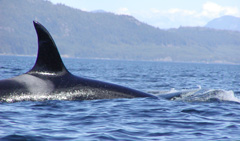 This population of Killer whales is distinct from the other killer whale populations occupying the waters of British Columbia. Bigg's killer whales are not as well understood as the Resident killer whales, as they are more difficult to detect, both visually and acoustically, because of their reliance on stealth when foraging.
 Adopt for yourself or someone else. A gift membership is a unique and thoughtful gift for people of all ages and all contributions go directly to research and conservation of killer whales in the wild. The B.C. Wild Killer Whale Adoption Program is hosted by the Vancouver Aquarium, a non-profit organization.